
Find Indiana Obituaries and Death Records
Indiana obituary records give you a way to confirm a death, trace family history, or settle legal matters. The Indiana Department of Health keeps death certificates for the entire state going back to 1900. Each of Indiana's 92 counties also maintains its own death records at the local health department. You can search for Indiana obituary information online, by mail, or in person at county offices across the state. This page explains where to look, who has the records, and what to bring when you make a request.
Indiana Death Records Quick Facts
Indiana Department of Health Vital Records
The Indiana Department of Health runs the Division of Vital Records. This is the main state office for death certificates. The office is at 2 North Meridian Street, Indianapolis, IN 46204. You can also write to P.O. Box 7125, Indianapolis, IN 46206-7125. The main phone is (317) 233-2700. State death records go from 1900 to the present day.
When you order a death certificate from the state, the fee you pay covers a search of the records. Under Indiana Code 16-37-1-11 and IC 37-1-11.5, the fee is for the office to search the files. If a record is found, the fee includes one copy. The fee is not refundable even if no record exists. The cost for the first death certificate is $8.00. Each extra copy ordered at the same time costs $4.00. These fees apply to mail and in-person orders at the state office.
The order page at in.gov/health/vital-records/order-now/ walks you through the mail process. You print State Form 49606, fill it out, and mail it with your ID and payment. Make checks out to the Indiana Department of Health.
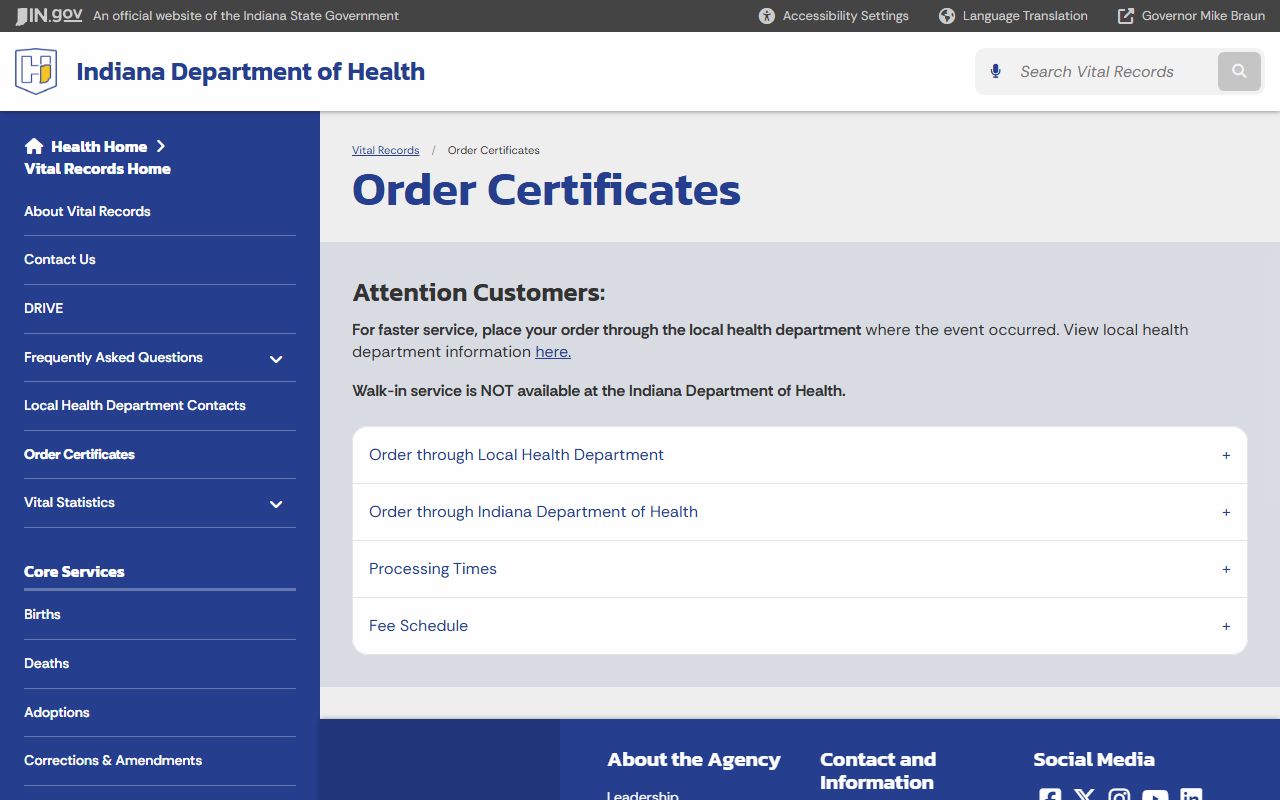
This is the official state form page for ordering Indiana death certificates by mail.
How to Order Indiana Death Certificates
Indiana offers three main ways to get a death certificate. You can order online, by phone, or by mail. In-person service at county health offices is also an option. Wait times and fees differ by method.
VitalChek is the only vendor the state has authorized for online orders. Their site is vitalchek.com. You can also call (866) 601-0891 to place a phone order. This line is open 24 hours a day, seven days a week. VitalChek adds a service fee on top of the $8.00 state fee. The company states: "We are an authorized online vital records ordering service for Indiana Department of Health. That means we can process your request fast, affordably, and securely." Phone orders through VitalChek work the same way as online orders.
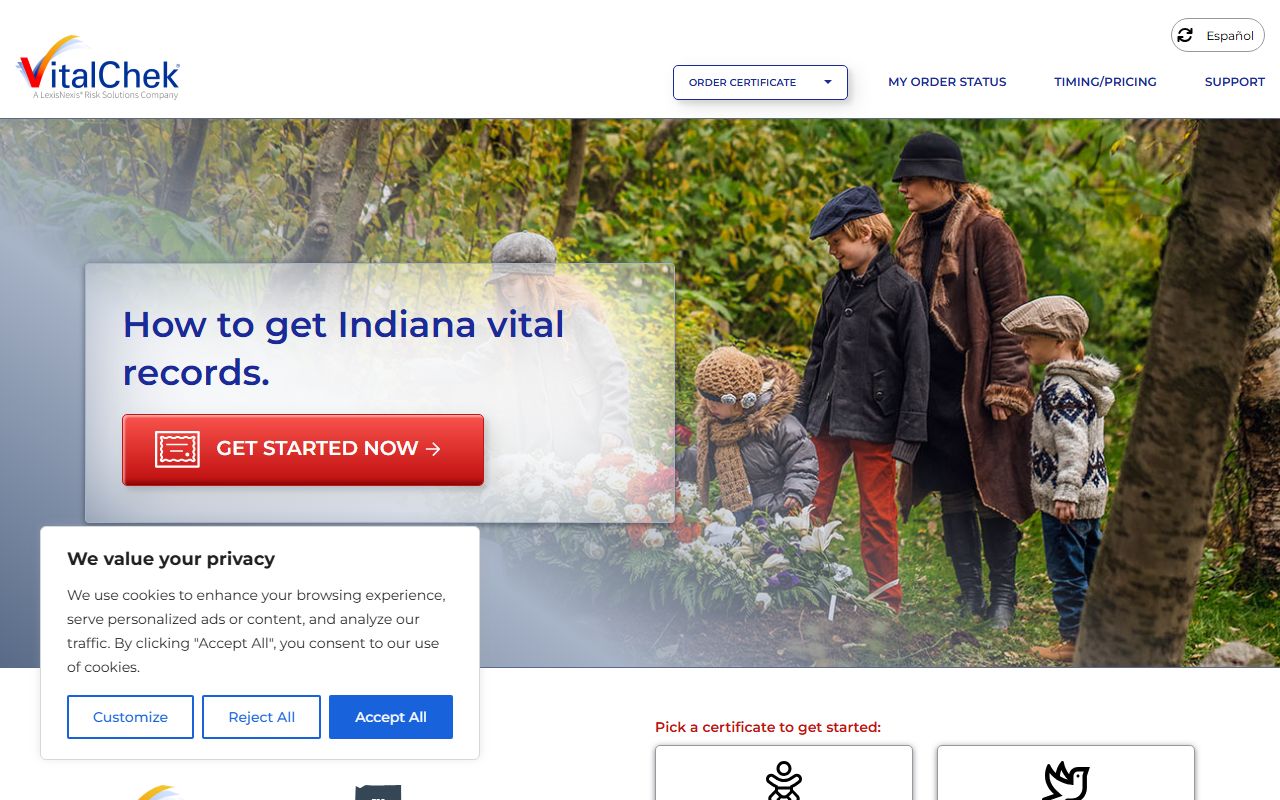
The VitalChek system is the fastest remote option for ordering Indiana death records and obituary-related vital records.
County health offices can also issue death certificates. Most issue them the same day for walk-in visits. Some counties have their own online portals too. Hamilton County uses hamiltoninvitals.permitium.com. County fees vary from $8 to $30 per certified copy. Most counties have records going back to 1882, which gives you deeper reach than the state office for older Indiana obituary research.
Note: Dearborn County and a few others can now issue death certificates for any Indiana county, which cuts travel for those who live far from where the death occurred.
Who Can Request Indiana Obituary Records
Indiana law limits who can get a certified copy of a death certificate. You must show direct interest in the record. This means you are a close family member, a legal rep, or you have a documented legal or financial need. The Indiana Department of Health keeps a full chart of who qualifies and what documents they need at in.gov/health/vital-records/home/.
Family members who qualify include parents, grandparents, siblings, children, grandchildren, and current spouses. Grandparents must show proof that they are a parent of a parent listed on the record. Step-parents can qualify but must show both ID and a marriage certificate. Court-appointed guardians and attorneys can get records with the right paperwork. Attorneys must show both ID and documentation of direct interest. Social agencies and state or federal agencies may also request records when they provide proper documentation of direct interest.
For genealogy research, you can get a non-certified copy if the person has been dead for over 75 years. This exception lets family historians access older Indiana death records and obituary information without proving direct interest. You still need to pay the search fee, which is not refundable under state law.
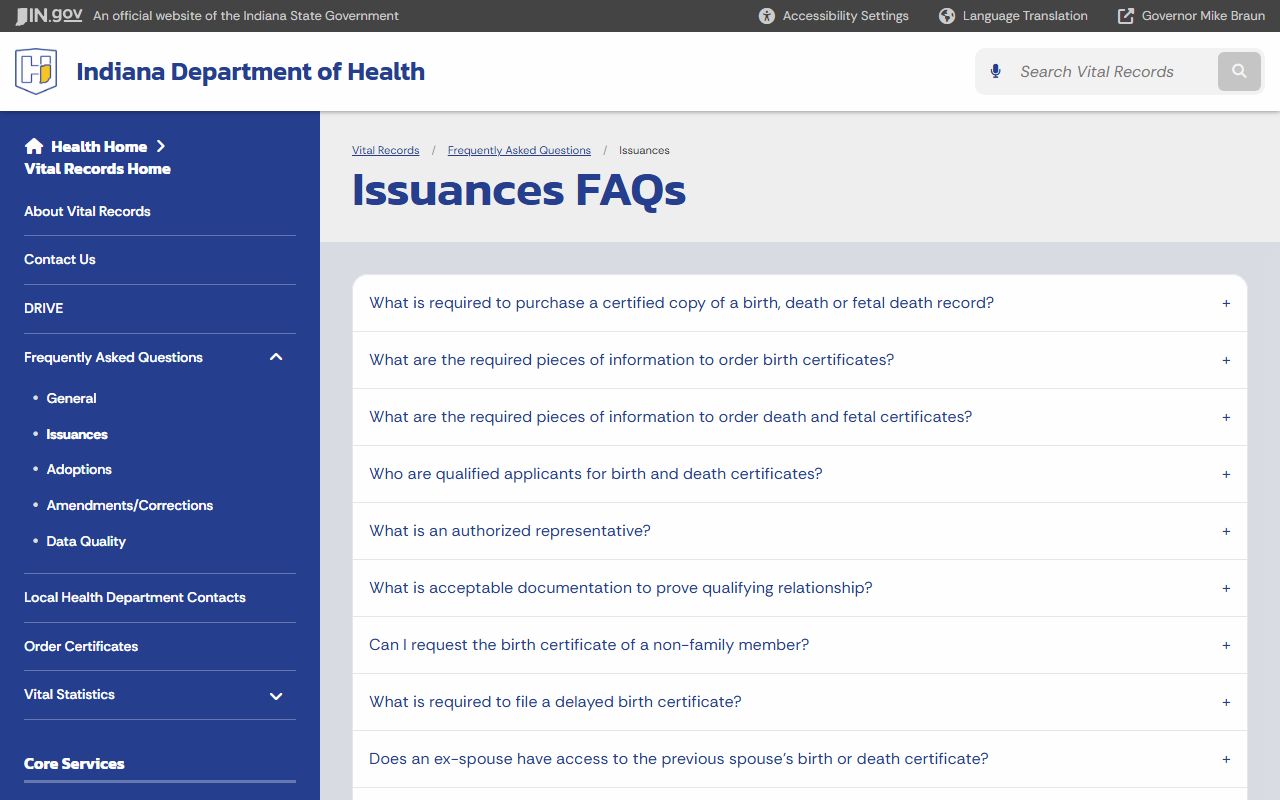
The FAQ page at in.gov/health/vital-records/frequently-asked-questions/issuances/ answers common questions about who can order records and what forms of ID the state accepts.
Under IC 16-37-3-9, certain basic facts from death records are open for public inspection. This includes the name, sex, age, place of death, and county of residence of the person who died. Full certified copies follow the direct interest rules above. Expired IDs and paper temporary driver's licenses are not accepted as identification at most county health offices in Indiana.
Indiana Obituary Databases and Free Online Resources
The Indiana Legacy database at digital.statelib.lib.in.us/legacy/ is one of the best free tools for finding Indiana obituary records. It combines data from libraries, historical societies, and genealogy groups across the state. The collection has 5,452,573 records spread across 22 separate indexes. You can search by county, event type, or surname. Records in the system include births, marriages, deaths, divorces, obituaries, court records, newspapers, scrapbooks, yearbooks, and military records.
The Indiana Legacy collection includes VINE Obituary Records, VINE Death Records, VINE Cemetery Records, VINE Biography Records, VINE Birth Records, and VINE Military Records. These are all searchable at no cost. Local libraries, genealogy groups, and historical societies across Indiana created and maintain this data. It stands as the largest free collection of Indiana vital and historical records available online today.
Hoosier State Chronicles at hoosierstatechronicles.org gives free access to Indiana's historic newspapers. You can search old newspaper pages for obituary notices going back over a century. The Indiana State Library operates this service. For older obituary searches, newspapers are often the richest source of detail about a person's life, survivors, and funeral arrangements.
What Indiana Death Records Contain
A standard Indiana death certificate shows the name of the person who died, date and place of death, and the county where death occurred. It also includes the person's age, sex, and state of residence. The certificate names the attending doctor or coroner and the funeral home that handled the case. Certified copies carry the raised seal of the health department that issued them. This seal is required for most legal uses. Faxed or photocopied certificates without raised seals are not valid for legal purposes.
County records often go back further than the state's 1900 starting date. Most counties have death records from 1882. Howard County has records as far back as 1875. Records from 1882 to about 1920 may be incomplete or harder to read in some counties. For deaths that predate county records, local libraries and genealogy centers sometimes hold transcriptions, cemetery records, or newspaper archives that fill the gaps in Indiana obituary research.
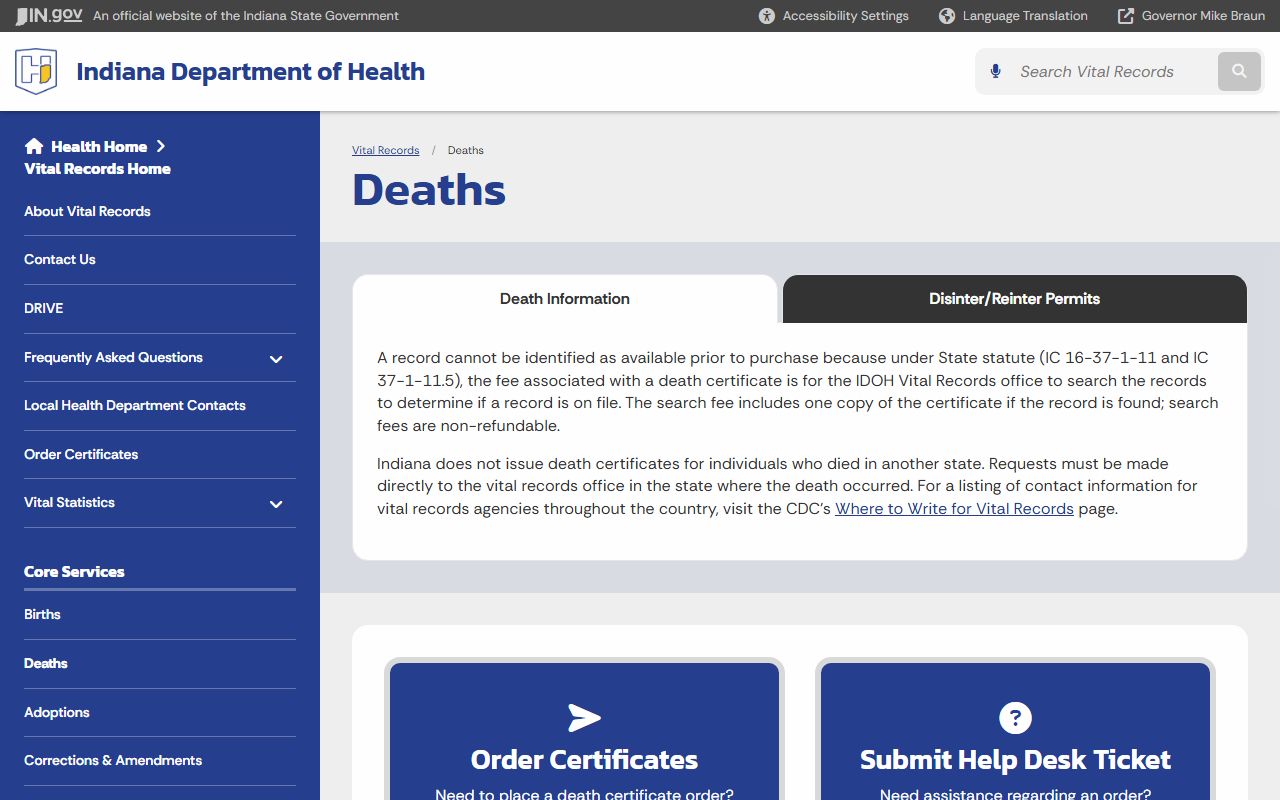
The death information page at in.gov/health/vital-records/death-information/ covers what the state requires to process your order and what documentation you will receive.
To order a record, the state accepts a government-issued driver's license, passport, US Military ID, Veterans ID, or a few other primary documents. If you only have secondary documents, you need two of them. Secondary options include a Social Security card, voter registration card, vehicle registration, or current home lease. Having your documents ready before you order speeds up the process.
Indiana State Library and Archives Genealogy Resources
The Indiana State Library Genealogy Division is at 315 West Ohio Street, Indianapolis, IN 46202. Call the reference desk at 317-232-3689. Hours are Monday through Friday, 8:00 a.m. to 4:30 p.m. The collection is one of the largest family history collections in the Midwest. It holds more than 40,000 print items including family histories, record indexes, cemetery transcriptions, and military pension records. The focus is on Indiana and nearby states, with some coverage of eastern and southern states. On Wednesday afternoons and the second Saturday of each month, volunteers from the Caroline Scott Harrison Chapter of the Daughters of the American Revolution are at the library to help with research. You can explore the collection at in.gov/library/genealogy.htm and access digital items at in.gov/library/online-resources/.
The Indiana State Archives is at 6440 East 30th Street, Indianapolis, IN 46219-1007. Reach them at 317-591-5222. The archives hold census records, military records, and original government records from all 92 Indiana counties. For death records and family history, the archives keep birth certificates, death certificates, and marriage records going back many decades. The Indiana State Archives also maintains an index of records that you can browse before visiting. See in.gov/icpr/archives/ for what is available and how to access the collections.
The Allen County Public Library Genealogy Center in Fort Wayne is at 900 Webster Street, Fort Wayne, IN 46802. The phone is 260-421-1225. You can email the staff at Genealogy@ACPL.Info. This center holds the second largest genealogy research collection in the United States, and the largest in any public library. The collection is mainly North American, with some material for the British Isles and other parts of Europe. The center has microfilm copies of marriage records for 31 of Indiana's 92 counties. Visit acpl.info/genealogy/ for more details on what they hold and how to plan a visit.
Are Indiana Obituary Records Public
Death records in Indiana have both public and restricted components. Under IC 5-14-3, the Access to Public Records Act, certain basic information from death records is open to the public. This includes the name, gender, age, place of death, and county of residence of the deceased. Anyone can inspect this basic data without proving a family relationship or legal interest.
Full certified copies of death certificates require direct interest. The state uses this rule to protect sensitive information that appears in the full record but not in the public summary. This system means researchers can confirm a death and get basic details through the public access rules, while the full document with medical and personal details stays protected. Many Indiana genealogy researchers use the Indiana Legacy database and county court records alongside public access rules to build out a complete picture of a person's life and death in Indiana.
County clerks in Indiana also hold related records that may include obituary-adjacent information. These include probate records, estate filings, and court orders tied to a person's death. Probate files often name the deceased, surviving heirs, and the property involved. These are generally public records open to anyone in Indiana.
Browse Indiana Obituary Records by County
Indiana has 92 counties, and each keeps its own death records at the county health department. Pick a county below to find local contact details, fees, hours, and resources for obituary and death records in that area.
Indiana Obituary Records in Major Cities
Most Indiana cities do not run their own health departments. Residents look up death records through the county health office. Gary, Fishers, and East Chicago each run their own city health departments. Pick a city below to find local obituary and death record resources.